

CUVIS-joint
Optimal surgical planning and precise cutting
CUVIS-joint
is a cutting-edge surgical robot system that improves the completion of artificial joint surgery with optimal surgical planning and precise cutting.
With optimal tracking sensors and self-developed surgical planning CUVIS-joint helps patients that are in need of artificial knee surgery.




Why CUVIS-joint is good?
-
Point. 01
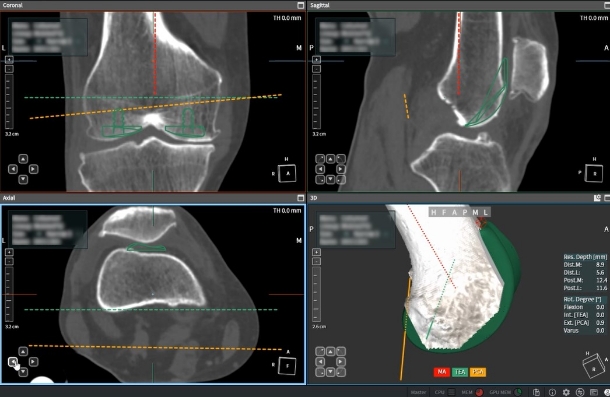
Surgical Planning & Execution Based on 3D CT Analysis
Surgical Planning & Execution Based on 3D CT Analysis
Precisely analyzes the patient's bone morphology based on pre-operative 3D CT images and accurately predicts femoral (98.9%) and tibial (100%) implant sizes.1
Precise Bone Resection
The robotic arm performs precise bone resection within a 1mm error margin (98% rate) within the planned range.1
Sophisticated Angle Control
Maintains the cutting angle error (RMS) below 1 degree, ensuring that simulation results are perfectly reproduced in the actual operating room.2
-
Point. 02
Optimal Soft Tissue Balance and Alignment
Real-time Gap Balancing
Checks and adjusts the gap balancing of the medial and lateral knee in real-time during surgery to support achieving ideal balance.3 4
Functional Alignment
Goes beyond simply straightening the bone by identifying the optimal rotational alignment reflecting the patient's specific rotational axes (TEA, PCA).5 6
Joint Line Restoration & Soft Tissue Preservation
Restores the anatomical position by maintaining pre- to post-operative joint line height changes at an average level of 1.65mm, and reduces the frequency of unnecessary soft tissue releases.7 8
References
-
1
Adkar N, et al. Correlation Between Planned and Executed Bone Cuts Using Robotics in Total Knee Arthroplasty: A Prospective Study of 500 Patients. Indian Journal of Orthopaedics. 2024.
-
2
Patil S, Wankhede C. Achieving Accuracy and Gap Balancing with Fully Autonomous Cuvis Joint Robot Assisted Total Knee Arthroplasty: A Single-Center, Non-Randomized Retrospective Study. Journal of Orthopaedic Reports. 2024.
-
3
Bhat AK, et al. Gap Balancing Technique With Functional Alignment in Total Knee Arthroplasty Using the Cuvis Joint Robotic System: Surgical Technique and Functional Outcome. Cureus. 2025.
-
4
Jung WH, et al. Evaluating the Accuracy of Cuvis™ Robot Assisted Total Knee Arthroplasty Using Offset Type Tensor System in Ligament Gap Balancing. Journal of Clinical Orthopaedics and Trauma. 2025.
-
5
Londhe SB, et al. Evaluation of the External Rotation of the Femur Component in Functionally Aligned Robotic-Assisted Total Knee Arthroplasty. Cureus. 2024.
-
6
Murugesan HK, et al. Assessment of Average Femoral Component Rotation for Balancing Functionally Aligned Total Knee Replacement in Varus Deformity: Robotic Image Guidance Study. Journal of Orthopaedics. 2024.
-
7
Londhe SB, et al. Minimized Soft Tissue Release in Robotic-Assisted Total Knee Arthroplasty: A Retrospective Review of 100 Cases. Cureus. 2024.
-
8
Bhor P, et al. Is Native Joint Line More Accurately Restored with Robotic Assisted Total Knee Arthroplasty than with Conventional Instruments? Journal of Orthopaedic Case Reports. 2025.
-
9
Chandrashekar P, et al. Intra-Operative Safety of an Autonomous Robotic System for Total Knee Replacement: A Review of 500 Cases in India. Indian Journal of Orthopaedics. 2023.
-
10
Mehta C, et al. Our Initial Experience of First 50 Cases of Robotic-Arm Assisted Total Knee Arthroplasty. Journal of Clinical Orthopaedics. 2024.
-
11
Bhattacharjee S, et al. Evolving Techniques in Active Robotic Arm-Assisted Total Knee Arthroplasty: A Retrospective Study of Pin Placement Strategies. Journal of Robotic Surgery. 2025.
-
12
Bhattacharjee SK, et al. Functional Outcome in Obese Patients Undergoing Image-Based Cruciate Retaining Robotic-Assisted Total Knee Arthroplasty Using the Subvastus Approach: A Short-Term Study. Cureus. 2024.
-
13
Rajashekhar KT, et al. Achieving Accuracy and Gap Balancing in Fully Autonomous Robotic-Assisted Total Knee Arthroplasty with Functional Alignment in Valgus Knee Deformity. Journal of Orthopaedic Case Reports. 2025.
-
14
Londhe SB, et al. Comparative Analysis of the Immediate Post-operative Outcomes between Conventional and Fully Automatic Robotic-assisted Total Knee Arthroplasty. Journal of Clinical Orthopaedics. 2023.
-
15
Han SH, et al. Clinical Benefit of Robotic-Assisted Total Knee Arthroplasty over Conventional Total Knee Arthroplasty When Using Mobile-Bearing Implants. Medicina. 2024.
-
16
Bhattacharjee S, et al. Comparative Analysis of Joint Awareness and Functional Outcomes in Robotic vs Conventional Total Knee Arthroplasty: A Retrospective Study with 1-year Follow-up. Research Article. 2024.
※ These products are medical robots. Please check the caution and instructions before use.
※ Disclaimer The advantages and safety data of robotic surgery presented herein are summarized based on multiple clinical research papers conducted using CUVIS-joint. This content summarizes clinical statistics and researchers' analyses; it does not guarantee the same results for all patients. We recommend consulting with a specialist for an accurate diagnosis.


